

✨ This article was AI edited. Editorial responsibility: ForsythGolf.biz.
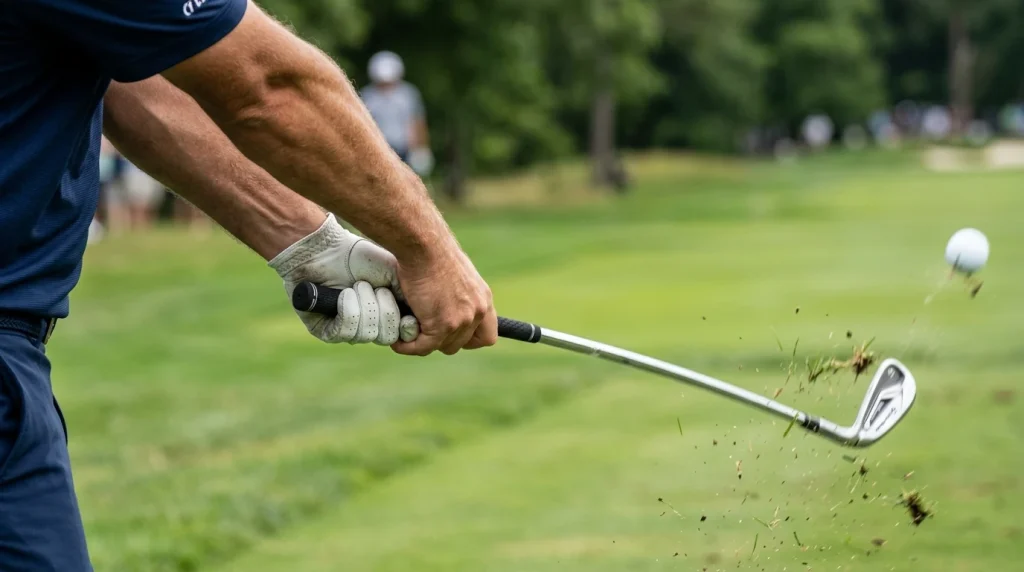
Active wrist action in the golf swing refers to the deliberate, coordinated mechanics of wrist flexion, extension, radial deviation, and ulnar unhinging used to control clubface orientation and maximize angular velocity. When properly synchronized with body rotation, active wrists produce crisp compression and prevent scooping.
For generations, amateur golfers have been bombarded with conflicting instruction regarding the wrists. One school of thought demands “dead, passive hands” to minimize moving parts and promote body-driven consistency. Another advocates an aggressive “wrist snap” through the ball to whip clubhead speed. The reality discovered through high-speed sports motion capture is that the wrists in an elite golf swing are neither passive nor wildly flippy—they are actively guided through precise biomechanical planes.
Mastering active wrist mechanics is the foundation of modern ball striking, as popularized by major champions like Dustin Johnson, Collin Morikawa, and Jon Rahm. This comprehensive guide breaks down the four anatomical movements of the wrists, explores how active control influences dynamic loft and face angle, and provides practical drills to build tour-quality compression.
The Four Dimensions of Wrist Movement in the Golf Swing
To control the golf club with athletic precision, a golfer must understand the two orthogonal axes that govern wrist mobility:
- Flexion (Palmar Flexion / Bowing): Bending the wrist toward the palm. In the lead wrist, flexion shuts the clubface and reduces dynamic loft, creating forward shaft lean and penetrating trajectory.
- Extension (Dorsiflexion / Cupping): Bending the wrist backward toward the knuckles. In the lead wrist, extension opens the clubface and adds dynamic loft, frequently causing slices and high, weak ballooning shots.
- Radial Deviation (Cocking / Hinging): Tilting the wrist vertically toward the thumb. This occurs during the backswing to create the primary power hinge of the golf club.
- Ulnar Deviation (Unhinging): Tilting the wrist downward toward the pinky finger. This occurs in the downswing delivery, allowing the clubhead to reach the turf and sweep or compress the ball cleanly.
Diagnostic Matrix: Passive vs. Active Wrist Mechanics
Compare how passive, inactive hands differ from mechanically active wrist control throughout the critical delivery and impact zones:
| Swing Parameter | Passive / Flaccid Wrists | Active, Biomechanically Controlled Wrists |
|---|---|---|
| Top of Backswing (P4) | Cupped lead wrist; clubface hanging open toward ground; excessive shaft collapse. | Flat or bowed lead wrist; clubface parallel to lead forearm plane; firm structural angle. |
| Delivery Transition (P6) | Wrists unhinge too early due to centrifugal force without face control; open face. | Wrist flexion actively maintained or increased (Motorcycle Move) to square face early. |
| Impact Position (P7) | Lead wrist collapses into extension (scoop); shaft leans backward; face angle erratic. | Lead wrist firmly in flexion; trail wrist in extension; hands forward with compressed strike. |
| Low Point Control | Inconsistent low point 2–4 inches behind the ball, causing fat and thin strikes. | Predictable low point 2–3 inches ahead of the ball, producing clean divots with irons. |
Why “Dead Hands” Often Ruins Amateur Golfers
Telling an amateur golfer to keep their hands passive almost always results in a wide-open clubface. Unlike a tennis racket or baseball bat, a golf club has its center of gravity positioned significantly behind the shaft axis. During the downswing, natural centrifugal force twists an unsupported clubface open relative to the swing arc.
If a player relies purely on passive hands, they arrive at delivery with a face pointing 15 to 20 degrees right of the target. To make contact, the player must either stall their body rotation and aggressively flip their trail hand at the last microsecond or stand up out of their posture (early extension). Active lead wrist flexion—often described as the “Motorcycle Throttle” move—pre-squares the clubface early, allowing the golfer to rotate through impact with complete freedom.
The Step-by-Step Active Wrist Protocol
Step 1: The Takeaway Cocking Sequence
During the one-piece takeaway (address to P2), the wrists remain quiet while the shoulders rotate. As the hands pass the trail thigh, initiate radial deviation (hinging toward the thumbs) without adding extension. The clubface should remain matching your spine angle.
Step 2: Top of Swing Lead Wrist Bowing
At the apex of the backswing, feel your lead wrist flatten or bow slightly outward toward the target. This ensures the clubface stays square to slightly closed relative to the swing path, eliminating any reliance on compensatory late-downswing manipulation.
Step 3: Downswing “Motorcycle” Flexion and Supination
During transition, actively turn the knuckles of your lead hand toward the ground, mimicking revving a motorcycle throttle with your left hand. This action combines lead wrist flexion with lead forearm supination, shallowing the club shaft onto the ideal delivery plane and locking the clubface square before the hands even reach waist level.
Step 4: Ulnar Unhinging Through Impact
From waist height to impact, actively unhinge your wrists into ulnar deviation (snapping the wrists downward toward the turf). Because the clubface was pre-squared in Step 3, you do not need to flip or twist the face. Simply drive the heel pad of the lead hand through the ball, holding lead wrist flexion through the strike.
Actionable Drills for Developing Active Wrist Control
The Ruler or Credit Card Glove Drill
Slide a 6-inch plastic ruler or stiff credit card into the back of your golf glove so that half of it rests against the back of your hand and half against your forearm. Make slow-motion backswings and downswings. If you cup your wrist at the top or at impact, the card will dig painfully into your forearm. Your goal is to maintain zero pressure against the back of the card, confirming a flat or bowed lead wrist throughout.
The Impact Bag Compression Drill
Set up to a heavy golf impact bag. Without making a full backswing, take the club back 2 feet and firmly drive into the bag. At the moment of contact, freeze your position and verify:
- Lead wrist is visibly bowed (in flexion).
- Trail wrist is bent back (in extension), resembling a waiter holding a tray.
- The shaft leans forward toward the target by 5 to 10 degrees.
Frequently Asked Questions
Does active wrist action promote a hook?
Only if the player rotates their forearms without continuing their core rotation. When paired with active hip and chest turn, active wrist flexion produces a powerful, penetrating draw that resists wind.
Can golfers with arthritis or wrist pain use active wrist action?
Yes. Proper biomechanical flexion and ulnar deviation distributes impact shock across the large muscles of the forearms and shoulders rather than concentrating hyperextension stress on the delicate carpal joints of the wrist.
How tight should my grip be when using active wrists?
Maintain a moderate grip pressure (approximately 4 or 5 out of 10). Clenching too tightly restricts natural ulnar deviation, while holding the club too loosely results in loss of clubface stability.
Get our latest guides, news, and insights highlighted in your Google Search & AI Overviews.



 ADD 15-30 YARDS GUARANTEED OR PAY NOTHING!