

✨ This article was AI edited. Editorial responsibility: ForsythGolf.biz.
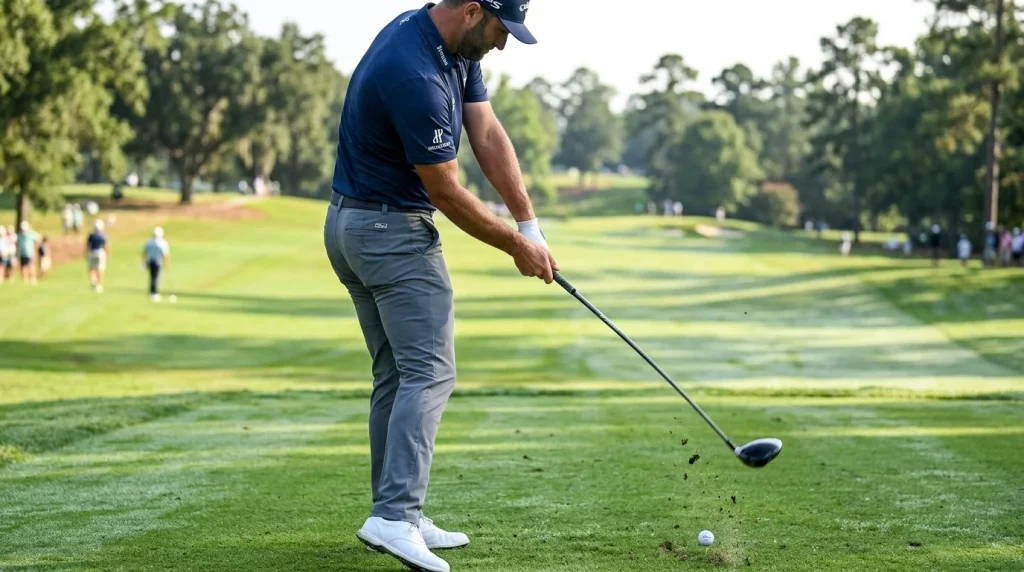
Early release for power in the golf downswing describes initiating the unhinging of the wrists and acceleration of the clubhead high in the downswing rather than holding artificial lag. This biomechanical sequencing maximizes angular momentum, optimizes the rate of closure, and generates explosive clubhead velocity at impact.
For decades, conventional golf instruction preached that maximum power comes from holding sharp wrist lag until the absolute last millisecond before impact. Golfers were told to pull the butt end of the club straight down toward their trail foot, striving for a severe acute angle between the forearm and shaft. In practice, however, holding lag artificially leads to a catastrophic loss of clubhead speed, open clubfaces, steep attack angles, and severe casting compensations.
Modern 3D biomechanical analysis and launch monitor data have revealed a startling counter-intuitive truth: elite ball strikers release their wrist angles far earlier than previously believed. By beginning the release high in the downswing, players leverage the physical laws of angular momentum and the double-pendulum model, allowing the clubhead to achieve peak kinetic speed exactly at impact. This guide deconstructs why an early, properly sequenced release produces effortless power and how to incorporate it into your swing.
The Physics of Lag: The Double Pendulum and Conservation of Momentum
The golf swing is fundamentally modeled as a double-pendulum system. The primary hub is the shoulder and torso rotation, while the secondary hub is the wrist joint holding the golf club. In any double-pendulum mechanism, maximum tip velocity (the clubhead) cannot be achieved by locking the secondary hinge until the bottom of the arc.
According to the principles of physics:
- Centrifugal Force & Inertia: As the arms accelerate downward during the transition, the heavy mass of the clubhead naturally pulls outward away from the center of rotation. Fighting this natural outward pull by clutching the wrists tightly creates muscular tension and slows down arm speed.
- Energy Transfer via Hinge Decoupling: When the golfer allows the wrists to unhinge progressively from the delivery position (between P4 at the top and P5 midway down), kinetic energy transfers smoothly from the large, slower-moving muscles of the core and shoulders into the lightweight, high-velocity clubhead.
- Peak Speed Timing: Holding lag too long causes the clubhead to accelerate after the ball has already been struck. An earlier release aligns peak angular velocity directly with the golf ball.
Diagnostic Comparison: Holding Lag vs. Efficient Early Power Release
Understanding the distinction between an uncontrolled “cast” and a purposeful “early power release” is essential for executing this mechanic correctly:
| Swing Feature | Destructive Casting (Over the Top) | Biomechanical Early Power Release |
|---|---|---|
| Initiation Point | Triggered by throwing the hands outward toward the ball from the neck/shoulder level. | Lower body shifts forward first; release begins smoothly as hands reach chest height. |
| Shaft Plane Angle | Steeps the shaft violently; cuts across the ball from outside-to-in (steep path). | Shallower shaft plane; club stays on or slightly behind the hand path (inside-out). |
| Wrist Action (Lead Wrist) | Cupping (extension) of the lead wrist, opening the clubface toward the sky. | Bowing or flattening (flexion) combined with progressive uncocking (ulnar deviation). |
| Rate of Closure at Impact | Violent, uncontrollable flip required to square the face; high timing sensitivity. | Smooth, predictable rate of closure; face remains stable and square along swing arc. |
| Strike Quality & Smash Factor | Fat shots, thin tops, high pop-ups, and weak glances with Smash Factor < 1.40. | Crisp, flush center-face strikes, penetrating trajectory, and tour-caliber Smash Factor (1.48–1.50). |
Why Trying to “Hold Lag” Destroys Distance and Accuracy
1. Creates Rigid Muscular Co-Contraction
When a golfer actively tries to hold wrist lag, the flexor and extensor muscles of the forearms contract simultaneously (co-contraction). Co-contracted muscles are tense and slow. Muscle tension acts as a brake on the swing, preventing the rapid reflex firing of fast-twitch muscle fibers required for 110+ mph clubhead speeds.
2. Delays Face Closure (The Inevitable Push-Slice)
Holding the handle forward prevents the toe of the club from rotating past the heel. By the time the hands arrive at the ball, the face is pointing 10 to 15 degrees right of the target line. The golfer either leaves the ball out to the right in an ugly push-slice or makes a desperate, panic-induced flip of the hands at the bottom, resulting in low pulls and duck-hooks.
3. Steepens the Angle of Attack
Pulling down on the butt of the club pulls the clubhead straight down toward the ground rather than swinging it outward around the body. With irons, this causes excessive divots and harsh impacts; with a driver, it leads to negative angles of attack, sky marks on the crown, and ballooning high-spin drives that fall out of the sky.
The 4-Stage Protocol for an Early Power Release
Stage 1: Soft Wrists at the Top of the Swing
Power cannot flow through rigid joints. At the top of your backswing, evaluate your grip pressure on a scale from 1 to 10. You should aim for a pressure level of 3. Soft wrists allow the weight of the clubhead to naturally set into full radial deviation without forced muscle tension.
Stage 2: Lateral-Rotational Lower Body Shift
Before the release begins, the pelvis must shift dynamic pressure into the lead heel and instep. This ground-up stabilization provides the immovable anchor that the upper body will whip against. Without this stable foundation, an early release degenerates into a scoop or cast.
Stage 3: Progressive Throw from Delivery (P5 to P6)
As your hands drop from shoulder level to waist level, feel as though you are skipping a stone across a lake or throwing an underhand ball toward the fairway. The wrists begin to unhinge in the direction of the target line while maintaining slight lead wrist flexion (flat or bowed lead wrist). You should feel the clubhead widening its arc away from you.
Stage 4: Acceleration Through Impact (P7) to Full Extension (P8)
Because the release was initiated early, the clubhead catches up with the hands precisely at impact. The momentum carries both arms into straight, effortless extension down the target line. The club feels light, as the kinetic energy has already been released into the golf ball.
Diagnostic Drills for Mastering the Early Power Release
The “Cast to the Wall” Indoor Drill
Stand with your back approximately 2 feet away from a wall (without a club or with a short foam practice rod). Take your backswing. As you start down, try to feel the back of your hands and the clubhead brushing the wall behind you as early as possible. This teaches you to widen the radius and release the club behind you rather than pulling the hands forward and steepening the shaft.
The Alignment Stick “Whoosh” Drill
Hold an alignment stick or an inverted golf club (holding the clubhead end with the grip swinging freely). Make vigorous downswings and listen carefully to the pitch and location of the “whoosh” sound.
- If you hold lag too long, the whoosh will sound late, well past the impact zone where the ball would be.
- If you cast over the top, the whoosh will occur prematurely at the top of your shoulders.
- When executing an early power release, the whoosh will peak loudly right at and slightly in front of the imaginary golf ball.
Frequently Asked Questions
Is an early power release the same as casting?
No. Casting is throwing the club outward from the shoulders on an over-the-top swing plane with an extended (cupped) lead wrist and open face. An early power release occurs from an inside path with a flat or bowed lead wrist and proper lower-body weight transfer.
Will an early release reduce forward shaft lean with irons?
Surprisingly, no. Because the clubhead is properly supported by the rotating body and lead wrist flexion, you will still achieve the optimal 2 to 4 degrees of forward shaft lean needed to compress iron shots without artificially shoving your hands forward.
How does this technique benefit golfers with slower swing speeds?
Golfers with moderate or slower swing speeds lack the physical strength to muscle a lagging club into the ball. Utilizing an early power release maximizes natural leverage and centrifugal force, allowing players to gain 10 to 20 yards of carry without swinging harder.
Get our latest guides, news, and insights highlighted in your Google Search & AI Overviews.



 ADD 15-30 YARDS GUARANTEED OR PAY NOTHING!