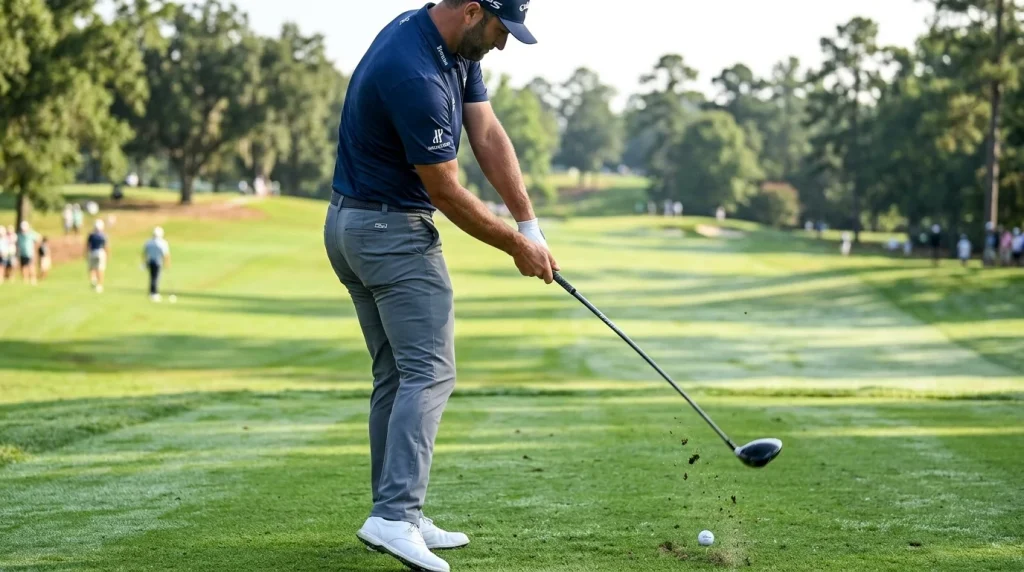
Golf Swing Biomechanics & Kinematic Sequencing is an anatomical rotary movement discipline analyzing thoracic-pelvic separation (X-Factor), ground reaction force vectors, wrist unhinging rates, and dynamic spine angle stability to maximize clubhead velocity and centered face strike efficiency.
Diagnosing early extension, maintaining side bend and pelvic tilt through the strike to pure irons flush.
Swing Positions (P1–P10) & Biomechanical Force Transmission
In elite golf coaching, the swing is systematically mapped across ten checkpoint positions (P1 through P10), from Address (P1), Shaft Parallel in Takeaway (P2), Lead Arm Parallel (P3), Top of Backswing (P4), Transition Shaft Parallel (P5), Delivery Position (P6), Impact (P7), Exit Shaft Parallel (P8), Chest Exit (P9), through Full Balanced Finish (P10). Dissecting the swing into discrete biomechanical segments enables targeted remediation of path errors without causing paralysis by analysis.
The critical transitional phase occurs between P4 and P6. Tour players average 45° of pelvic rotation and 90° of shoulder rotation at P4, creating 45° of “X-Factor Stretch.” As the lower body shifts pressure into the lead side and rotates open toward the target, this muscular pre-stretch of the abdominal obliques and latissimus dorsi snaps the upper torso into the hitting zone with whip-like acceleration. Maintaining side bend (tilting the spine away from target) preserves room for the trail elbow to tuck tightly into the ribcage, slotting the club on an in-to-out attack plane.
Swing Position
Key Anatomical Alignment
Face-to-Plane Relationship
Common Amateur Fault
P2 (Takeaway Parallel)
Shaft parallel to ground and target line
Toe slightly tilted, matching primary spine angle
Rolling hands inside, fanning clubface open to sky.
P4 (Top of Backswing)
90° shoulder turn, 45° hip turn, trail leg braced
Flat lead wrist parallel to leading edge plane
Cupped lead wrist opening clubface 30° wide.
P6 (Delivery Slot)
Hips 30° open, trail elbow tucked against lead hip
Shaft shallowing slightly behind hands
Steep over-the-top chop across target line.
P7 (Impact Zone)
Hips 45° open, shoulders 20° open, hands forward
Square face with 2°–6° forward shaft lean
Scooping with wrists behind ball; thin/fat contact.
What is the primary cause of ‘early extension’ in the downswing?
Early extension occurs when a golfer thrusts the hips toward the ball and stands up out of posture. It is commonly triggered by an open clubface or steep shaft plane, forcing the golfer to stand up to make contact.
How does bowing the lead wrist at the top affect ball flight?
Bowing (flexing) the lead wrist (like Dustin Johnson or Collin Morikawa) closes the clubface relative to the swing plane, delofts the club, and eliminates the need for rapid active wrist rotation through impact.
What is the ideal hip-to-shoulder turn ratio at the top of the backswing?
The standard tour benchmark is approximately 45 degrees of pelvic rotation and 90 degrees of torso/shoulder rotation, creating a 45-degree differential known as the X-Factor for rotational power storage.
The spine and shaft 90-degree angle at address refers to the classic geometric alignment where a golfer's forward spine tilt sits roughly perpendicular to the club shaft plane. While…
Gravity centered golf is a rotational swing methodology centered on maintaining dynamic equilibrium over the body's center of mass throughout the swing. By harnessing gravitational acceleration and centrifugal torque…
Active wrist action in the golf swing refers to the deliberate, coordinated mechanics of wrist flexion, extension, radial deviation, and ulnar unhinging used to control clubface orientation and maximize…
Early release for power in the golf downswing describes initiating the unhinging of the wrists and acceleration of the clubhead high in the downswing rather than holding artificial lag.…
Lifting the lead heel in golf is the intentional upward elevation of the front foot's heel during the backswing to facilitate unrestricted pelvic rotation, increase thoracic shoulder turn, and…
Getting the driver ahead of the body refers to sequencing the kinetic chain so the clubhead releases past the torso immediately after impact, rather than lagging behind an over-rotated…
Unlock your golf potential by understanding club shaft length for maximum distance gains! Did you know that even a small adjustment can dramatically improve your drive? Dive into the science behind shaft length and discover how to send that ball flying further than your last round’s scorecard could even dream! Let’s elevate your game—one inch at a time!
Are your doors swinging off-kilter? Discover how the "Top of the Swing Hinge: Avoid Cupping or Bowing for Better Control" can keep your doors aligned and your sanity intact! Cupping and bowing are door drama staples—let's eliminate them with some smart techniques. Read on for insights that could save you from a wobbly entrance (and maybe a few future headaches)!
In the journey toward success, the mantra "Follow Through Don’t Quit Early: Finish Strong for Better Results" rings true. Think of it as running a marathon—stopping at mile 20 guarantees only a mediocre finish and an out-of-breath snack break. Studies show that consistent effort yields 30% better outcomes than early exits. So, lace up your shoes and let’s dive into why perseverance is your secret weapon for achieving goals!
Looking for the top 5 golf clubs in 2024? Whether you're slicing it off the tee or driving like a pro, we’ve got the best choices for every skill level! From beginners finding their swing to seasoned golfers perfecting their game, our guide offers expert insights and fun facts that will keep you on par. Ready to elevate your game? Let’s dive into the top picks that are sure to turn your golf outings into victories!